

Defining the Manosphere
The Manosphere is a social phenomenon that has been a self-defense reaction by men to the increasing loss of male political power over Fatherhood, Childhood, Motherhood, male-female relationships, and the civilization design of mankind since ancient times as a result of the increasing malevolent hegemony of organized man-hating (aka, organized misandry) over the civilization design of Homo sapiens. The Manosphere added its online presence to the Internet in the last century.
In our book, “The Misandry Problem: The Bizarre, Insane World of Man-Hating,” we categorize organized misandry as a Misandrous Predatory Social Force (MPSF) that has brutalized ethical male well-being since ancient times.
The messages of the Manosphere first appeared in written form inscribed on clay tablets by ancient Sumerian scribes, and many of those clay tablets have survived for thousands of years. The Sumerian cuneiform writing system was used in ancient Mesopotamia by Sumerians, Hittites, Akkadians, Babylonians, Assyrians, ancient Persians, and many others for over three thousand years. The following Sumerian-Akkadian scribal quotes point to the existence of the MPSF in ancient times, and they are some of the first written ideas pointing to the loss of male power over Fatherhood, Childhood, Motherhood, male-female relationships, and civilization design.
The scribal quotes that follow are from ETCSL (https://etcsl.orinst.ox.ac.uk/cgi-bin/etcsl.cgi?text=c.6.1*#) a project of Oxford University.
“A man’s waterskin is his life. A man’s sandals are his eyes. A man’s wife is his supervisor…A man’s daughter-in-law is his policeman.” (If “A man’s wife is his supervisor” and his daughter-in-law can exercise female sovereign power over him too, a husband would not have had much meaningful ability to influence the upbringing of his children, the behavior of his wife, or any female. It took a certain amount of time to prepare a clay tablet to be able to write on it. This scribe would have not taken the time to inscribe these words on a tablet that took time to prepare and store away if the idea that the wife was the “supervisor” of her husband had not been a widespread well-known social norm that should be revealed by recording the concept on a clay tablet.)
“The married man, having divorced his wife, examined her: ”At least I am taking away my dignity!” (If “dignity” was all a man had left after the ancient divorce proceedings, what happened to his Fatherhood rights, father-child relationships, his home, his income, his social life, and his personal property? Today, under the totalitarian, anti-male Family Court System’s lawfare guillotine, many men do not even have their “dignity” after the divorce proceedings.)
“A malicious wife living in the house is worse than all diseases.” (Would an ancient Mesopotamian man have married a woman knowing that she was “malicious” before he married her? She had to have hidden her malevolence before the wedding. Today’s social norms and family law greatly restrict a man’s ability to seriously deal with a “malicious” wife or a wife who has mental illness as in the case of Lindsay Clancy who viciously killed her children. If a man wants children and his serious belief system views abortion as ending life, he has no control over saving his unborn child from a surgeon’s sharp-bladed scalpel. During marriage, a man has few options if he learns that his “malicious” wife is instilling parental alienation indoctrination against Fatherhood in his children. After the wedding, when an ancient Sumerian man discovered that his bride was truly “malicious” and “worse than all diseases,” why didn’t he just ask her to leave and live with someone else? The answer is a question. What was the true social and financial cost of divorcing a wife after discovering her malevolence in Sumer and Akkad?)
“Who has not supported a wife or child, his nose has not borne a leash.“ (In ancient Sumer and Akkad, a “leash” was commonly used to control the movements of a full-grown bull, so it had to be extremely strong. Today, most pet owners use a leash to control the movements of a cherished pet dog while taking a leisurely stroll. In this scribal quote, mentioning a leash would not have evoked an image in anyone’s mind of a modern leash controlling a small dog. A bull’s leash would have been attached to a nose ring which would also control where the bull’s eyes could see. It would be a leash that would firmly control every movement of a bull. A bull also symbolized human masculinity in ancient Sumer, Akkad, and Babylon. From the above scribal quote, we see that men were expected to be the providers of a “wife or child,” and from the previous quote, the husband’s “supervisor” was his wife. The leash symbolized a man’s social, psychological, and financial movements being supervised and controlled by his wife. Fatherhood, Motherhood, Childhood, and the male-female relationships, including husband-wife relationships, would have also been managed by the wife in her “supervisor” role)
From the above scribal quotes, who would have had the most influence in defining Fatherhood, masculinity, Motherhood, Childhood, and all male-female relationships in that time period? Who would have had a serious influence on male-female relationship social norms, marriage-divorce customs and law codes such as The Law Code of Ur-Nammu, and all written law today which is part of our civilization design? The above scribal quotes are still part of the offline and online Manosphere. The organized malevolence of women manifests itself as the MPSF with its organized man-hating and the hatred of a father’s children. As long as women viciously murder their children as in the case of Lindsay Clancy and many others, and as long as women maliciously dominate over Fatherhood rights, Motherhood rights, Childhood rights, male-female relationships, and our civilization design, there will be a need for a Manosphere. The MPSF has strived to gain a monopoly control over Parenthood for thousands of years, and now it is one of its strongholds in its eternal war against civilizational masculinity and Fatherhood.
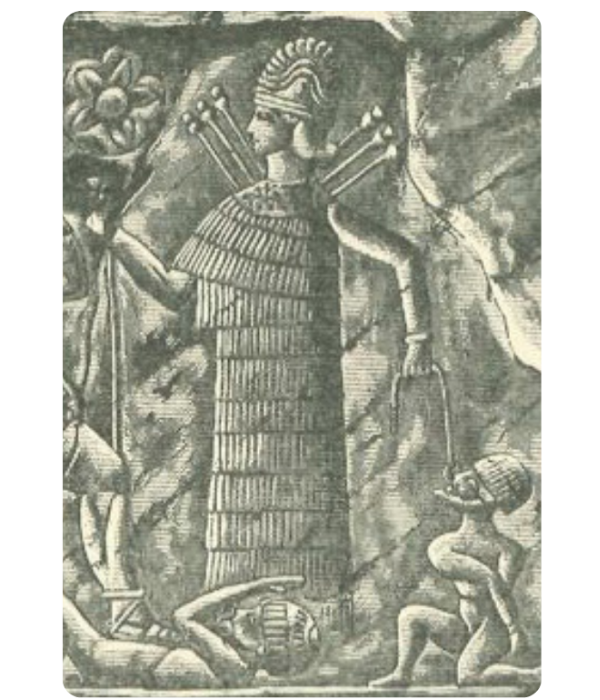
Thousands of years ago, the organized misandry of Sumer invented the malicious, oddball idea of a man on a leash that symbolized a domesticated male exploited by a man-hating woman. Who would concoct such a bizarre, cruel idea as a man controlled by a leash? What can the symbolic, hateful idea of a man on a leash teach us? The above drawing illustrates this societal norm with its Akkadian-Old Babylonian cultural symbolism as explained in our book, The Misandry Problem, The Bizarre, Insane World of Man-Hating.” The woman in the drawing is the goddess Ishtar (aka, Inana, in the Sumerian language). She is shown wearing the royal kanaukes outfit of female ruling elites which was also the outfit goddesses were shown to wear.
The above open source image is part of a larger image from an old reference set authored by Gaston Maspero who was a French Egyptologist and Director General of excavations and antiquities for the Egyptian government. It is a drawing of an origanal artifact as explained in our book, “The Misandry Problem, The Bizarre, Insane World of Man-Hating.” The drawings of actual artifacts in Gaston Maspero’s books were published in 1902. The larger a person was, the higher the social status. The smaller a person was, the lower the social status of that person. The domesticated male aristocrat that is on Ishtar’s leash is the size of a pet dog.